Skin Care: How to Layer Products and Choose Acne Treatments

More products don’t automatically make a better skin care routine. Apply products from thinnest to thickest, then finish your morning routine with sunscreen. At night, use a targeted treatment before moisturizer.
It’s easy to see why the order can feel confusing. Cleansers, toners, exfoliants, serums, moisturizers, and acne treatments each have a role, but adding them all at once can make a routine harder to follow. A simple sequence gives each step a clear place.
Here, you’ll learn how to layer products, build a routine around your skin’s needs, and choose cleansing, exfoliating, toning, and acne-treatment options. We’ll also cover when a gentle approach makes more sense than adding another step, so your routine stays clear, comfortable, and practical.
Key Takeaways
- Use a simple product order to make each step easier to fit into your morning or evening routine.
- Compare acne-treatment options by their active ingredients, and learn when exfoliating may call for extra care.
- Start with your skin’s needs to shape a routine you can keep consistent.
- See how cleansing, exfoliating, toning, targeted treatments, and moisturizing can each fit into a routine.
- Learn when general product guidance may not be enough and what a dermatologist can help assess.
1. Should I apply skin care products in a certain order?
Yes. A simple routine usually moves from cleansing to lighter leave-on products, then moisturizer. In the morning, finish with sunscreen. At night, apply a targeted treatment after cleansing and before moisturizer, following its label. This sequence helps products sit comfortably and makes it easier to identify a step that may be irritating.
Use product texture as a practical guide. A watery toner or serum generally goes before a thicker cream. Cleansers remove surface dirt and makeup, while moisturizers help reduce dryness. Exfoliants remove dead surface cells, and targeted treatments address specific concerns. You don’t need every category in one routine. Choose steps that serve a clear purpose.
For acne, topical benzoyl peroxide is one ingredient to consider. In the United States, these products are typically available in concentrations from 2.5% to 10%. The right choice depends on the product directions and how your skin responds. For other concerns, compare ingredient labels with your goal, such as dryness or uneven texture, rather than choosing by a product’s name alone.
Price alone doesn’t show whether a product will suit you. Drugstore and premium products can differ in ingredients, texture, packaging, and added features. Compare the active ingredients, directions, and full formula with your needs. A well-chosen cleanser and moisturizer may serve you better than several products selected only for a high-end label.
A basic routine’s cost in the United States depends on the steps you include, product sizes, and how often you replace them. A cleanser, moisturizer, and morning sunscreen make a simple starting point. Adding a serum, toner, exfoliant, or acne treatment changes the total. Start with necessary steps, then add products only to address a specific need.
Some active ingredients can irritate skin when layered together, especially if you introduce several treatments at once. Rather than treating every ingredient pairing as universally unsafe, follow each label and introduce one new product at a time. If your routine includes multiple exfoliating or acne-focused steps, separating them between morning and evening can make changes easier to track.
Irritation may appear as stinging, redness, itching, or dryness after applying a product. An allergy can also cause itching and a rash, but appearance alone can’t confirm the cause. Stop using a product that triggers a reaction, and note its name and ingredients. A careful patch test before regular use can help reveal whether a formula bothers your skin.
Product reviews can help compare texture, packaging, and ease of use, but individual experiences don’t establish how a formula will work for you. Check the ingredient list and directions, then make one change at a time. According to the U.S. Food and Drug Administration, prescription drugs must undergo an approval process before sale, while cosmetics do not require FDA approval before sale but remain subject to labeling and safety regulation.
2. Acne treatments
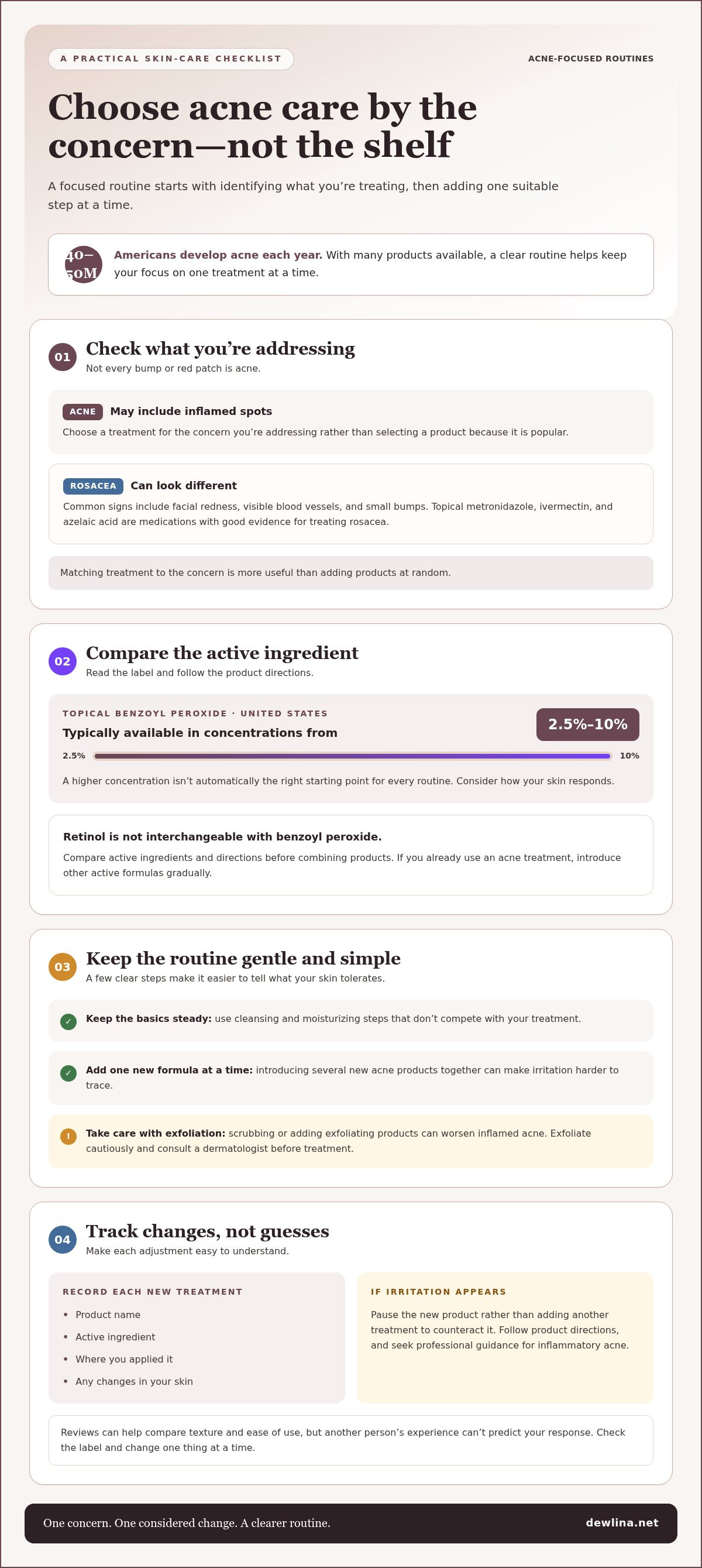
Choose acne treatments by the concern you’re addressing, not by a product’s popularity. Acne can include inflamed spots, while other facial changes may need a different approach. Between 40 and 50 million Americans develop acne each year, so product shelves offer many options. A clear routine helps you focus on one treatment at a time.
Topical benzoyl peroxide products in the United States are typically available in concentrations from 2.5% to 10%. Read the label and follow its directions. A higher concentration isn’t automatically the right starting point for every routine. Consider how your skin responds, and avoid adding several new acne products together, which can make irritation harder to trace.
Retinol may appear on ingredient labels, but it isn’t interchangeable with benzoyl peroxide. Compare each active ingredient and its directions before combining products. If you already use an acne treatment, introduce other active formulas gradually. Keep the rest of your routine simple, with cleansing and moisturizing steps that don’t compete with the treatment.
Exfoliation requires care if acne is inflamed. Scrubbing or adding exfoliating products can worsen the condition, so people with inflammatory acne should exfoliate cautiously and consult a dermatologist before treatment. Don’t treat soreness or redness as a signal to exfoliate more. A gentle routine is a better starting point while you assess what your skin tolerates.
Not every facial bump or red patch is acne. Rosacea commonly causes facial redness, visible blood vessels, and small bumps. Topical metronidazole, ivermectin, and azelaic acid are medications with good evidence for treating rosacea. The distinction matters: acne products may not address another skin concern, and matching treatment to the condition is more useful than adding products at random.
Keep a simple record as you try a treatment. Note the product name, active ingredient, where you applied it, and any changes in your skin. Introduce one new formula at a time and follow its label. If you notice irritation, pause the new product rather than adding another treatment to counteract it.
Reviews can help you compare texture and ease of use, but one person’s experience can’t predict your response. Check the label for the active ingredient and directions, then choose based on your concern and current routine. For inflammatory acne, professional guidance matters before treatment. For other concerns, don’t assume an acne-labeled formula is a universal solution.
Once you’ve identified the kind of treatment your routine needs, browse everyday skin care products as you consider how new steps fit with your existing products.
3. Building a skin care routine
Start by noticing how your skin feels after cleansing and throughout the day. Dermstore advises determining your skin type before investing in products, so your routine suits your needs. For example, note whether your cheeks feel dry while your forehead becomes shiny. Look for patterns rather than choosing products based on a trend or age alone. A person’s 20s is an ideal time to start a routine, but a useful routine can begin at any age.
For beginners, keep daily steps simple. In the morning, cleanse, moisturize, and finish with sunscreen. In the evening, cleanse and moisturize. Add a targeted product only for a clear reason, such as dryness or acne. This basic pattern makes it easier to notice how your skin responds and which step may need adjusting.
Age can influence what you want from a routine, but it shouldn’t dictate every product. Someone in their 20s may focus on consistent cleansing, moisturizing, and sun protection. Later, a person may choose to address a particular concern with a targeted formula. Begin with what your skin is doing now, then add a step only when it serves a specific purpose.
Dry skin often feels tight after washing or looks flaky around the cheeks. Choose a gentle cleanser and follow it with moisturizer while your skin is slightly damp. Avoid repeated exfoliation, which can make dry areas feel more uncomfortable. If a new product causes stinging or persistent redness, pause it and return to familiar basics.
If your skin feels oily in some areas and dry in others, choose products to suit those differences. Apply moisturizer across your face, then use a small amount of a targeted product only where needed. Too many new products at once can leave your skin feeling unsettled. Introduce one product, keep the rest of your routine familiar, and note any changes before adding another.
Moisturizer is a practical step for dry or tight-feeling skin. Collagen Peptide Daily Moisturizer is one option for this step. Follow its label and use it in place of another moisturizer, rather than adding it alongside several similar creams. A useful routine doesn’t need a long product list. Keep the steps that suit your skin, and adjust one at a time as your needs change.
4. Cleansing, exfoliating, and toning
A routine may include cleansing, exfoliation, toning, targeted treatment, and moisturizing. Each step has a different role, so choose based on your skin’s needs. A cleanser removes makeup, oil, and daily buildup. Follow with leave-on products, then moisturizer. In the morning, finish with sunscreen. If your routine already feels comfortable, a toner or exfoliant isn’t essential.
Choose a cleanser that leaves your face feeling comfortable after rinsing. If your skin feels tight or looks flaky, the formula or cleansing frequency may be contributing to dryness. Try a gentler cleanser and avoid scrubbing with a washcloth. Remove makeup before applying your other evening products. Clean hands also help keep the process simple and prevent residue from daily tasks from transferring to your face.
Exfoliation removes dead surface cells, but more isn’t always better. Physical scrubs use particles or textured surfaces, while chemical exfoliants use ingredients that loosen surface buildup. Choose one approach, follow its label, and watch for dryness or stinging. People with inflammatory acne should exfoliate cautiously because it may worsen the condition, and consult a dermatologist before treatment.
Toners are leave-on liquids applied after cleansing. Formulas vary, so read the ingredients and directions rather than assuming every toner serves the same purpose. If a toner leaves your skin feeling tight, stinging, or uncomfortable, stop using it. A simple routine can skip toner altogether. Cleanser, moisturizer, and sunscreen cover basic daily steps without another product.
Retinoids, exfoliants, and other active ingredients can cause irritation, including dryness, redness, or stinging. Using several active products together can make it harder to identify what is bothering your skin. Introduce one new formula at a time and follow its label. If you have inflammatory acne, avoid aggressive exfoliation, since it may worsen the condition.
Makeup tools also need care. Foundation brushes can hold makeup residue, so clean them regularly and let them dry fully before using them again. A brush-cleaning device can help with this separate tool-care task, but it doesn’t replace washing your face. Cleanse your face gently, then pat your skin dry with a clean towel instead of rubbing.
After cleansing, check how your face feels before choosing the next step. If it feels dry, simplify your routine and focus on moisturizer. If an exfoliant or toner feels uncomfortable, pause it rather than adding another active formula. A short routine with clear steps makes it easier to identify what suits your skin and what doesn’t.
5. Dermatologist-recommended skin care
“Dermatologist-recommended” is most useful when the advice matches a clear concern. A product that suits someone with dry skin won’t automatically suit someone managing acne or redness. Start by naming your goal, such as reducing dryness or choosing a gentle cleanser. Then compare the product’s ingredients and directions with that goal. A dermatologist can help assess persistent symptoms and distinguish conditions that may look similar.
For example, rosacea commonly causes facial redness, visible blood vessels, and small bumps. Topical metronidazole, ivermectin, and azelaic acid are medications with good evidence for treating rosacea. These treatments differ from general skin care recommendations. If redness or bumps concern you, focus on identifying the condition rather than choosing products based only on a “for redness” label.
Psoriasis is a long-lasting, noncontagious autoimmune disease marked by patches of abnormal skin. Topical skin-care agents are typically used for mild psoriasis. This illustrates why advice should account for the condition and its severity. A moisturizer can be part of everyday care, but it shouldn’t be confused with a treatment plan for psoriasis or another diagnosed concern.
Use a simple process to choose everyday products. First, identify your concern. Next, read the ingredient list and directions. Then consider whether the formula fits the rest of your routine. Introduce one new product at a time, so you can track changes without confusing several new steps. Reviews may describe texture or ease of use, but they can’t tell you whether a medicine is appropriate for your symptoms.
In the United States, product categories matter. According to the U.S. Food and Drug Administration, prescription drugs must undergo an approval process before sale, while cosmetics do not require FDA approval before sale but remain subject to labeling and safety regulation. Read the product label carefully, and don’t treat cosmetic claims as a substitute for medical advice about a diagnosed condition.
A dermatologist’s guidance is especially relevant when a concern persists, worsens, or doesn’t fit a product’s intended use. Bring the product name and ingredient list, along with notes on where and when symptoms appear. This can help you discuss what you’ve tried and how your routine is changing. Keep everyday care simple while choosing products that match your needs.
Once you’ve identified the everyday steps that suit your skin care routine, explore Dewlina’s products and compare their details with your goals.
Dewlina: Dr.Melaxin Collagen Wrinkle Balm Stick
Dr.Melaxin Collagen Wrinkle Balm Stick offers a balm-stick format for a focused step in your routine. Consider it when you want to add a balm alongside your usual cleansing and moisturizing steps. Follow the product directions, and keep products for different needs in their own routine steps.
For a cream step, Dewlina also offers NIDA Youthful Formula Moisturizing Face Cream and Collagen Peptide Daily Moisturizer. Color Changing Lip Oil is another option for lip care. Choose based on the type of product you want to add, rather than treating these formats as interchangeable. A balm stick, face cream, moisturizer, and lip oil each have a different place in everyday personal care.
For a closer look at these everyday options, visit dewlina.net.
Make your next routine step a simple one
Choose one product that addresses a clear need, then give it a thoughtful place in your routine. Follow its directions and notice how it fits alongside the products you already use. A useful skin care routine can change as your needs shift. You don’t need to add several new steps at once.
If you’re choosing a moisturizer or balm, Dewlina offers Dr.Melaxin Collagen Wrinkle Balm Stick, NIDA Youthful Formula Moisturizing Face Cream, and Collagen Peptide Daily Moisturizer. Compare their formats and product details to decide which suits the step you want to add. Keep your skin care choices intentional and your everyday routine comfortable.
Explore Dewlina’s everyday beauty products as you consider your next addition. Start with what feels useful, and build from there at your own pace.
Frequently Asked Questions
Should I apply skin care products in a certain order?
Yes. A consistent order makes your routine easier to follow. Check each label for specific directions, especially if a treatment says to apply it to clean, dry skin. Keep the treatment instructions in mind as you work out how it fits into your daily routine. If something feels uncomfortable, note the product and application time before changing other steps.
WANT MORE SKINCARE TIPS AND TRICKS?
Try keeping a brief product journal. Record the product name, when you used it, and any noticeable changes in your skin. If you introduce a new serum, leave the rest of your routine unchanged for a clearer comparison. Close containers after use, store them as directed, and avoid sharing applicators. These habits help keep your routine organized and make product choices easier to review.
What does dermatologist recommended skin care mean?
It means a dermatologist has recommended a product or approach for a particular purpose. It doesn’t automatically mean that choice suits everyone or every concern. Look for the reason behind the recommendation, such as addressing dryness or supporting care for a diagnosed condition. Check the product’s directions and ingredients, too. Guidance for one concern isn’t proof that a product will help with another.
What is the best skincare routine?
The best routine is one that suits your needs and is manageable enough to follow. For example, if your face feels tight after washing, consider whether your cleanser or moisturizer feels comfortable. If you’re adding a treatment, keep familiar steps steady so you can notice how the change fits. Adjust one product at a time rather than changing your whole routine at once.
What is the correct order to apply skin care products?
Follow the directions on each product, especially when a treatment gives specific application instructions. As a general guide, cleanse first, apply leave-on products, then moisturize. In the morning, use sunscreen as the final step. If product labels specify a particular sequence, follow those directions. A repeatable order can make daily application easier without requiring extra products.
How much does a basic skin care routine cost in the United States?
The cost depends on which steps you include, product sizes, and how often you replace them. A cleanser, moisturizer, and morning sunscreen are a simple starting point; adding other products changes the total.
What skin care ingredients should not be used together?
The article doesn’t identify specific ingredient pairs as universally unsafe. Follow each product’s label, introduce one new product at a time, and consider separating multiple exfoliating or acne-focused steps between morning and evening.